


E-Invoicing in UAE
E-invoicing is rapidly becoming a global standard, with more than 80 countries already implementing similar systems. The UAE Ministry of Finance has officially declared its intention to introduce invoicing in 2026, highlighting the country’s goal to innovate quickly and digitalize its economy. This commitment aligns with international standards and enhances the potential for global integration.
With Saudi Arabia introducing e-invoicing in December 2021 and regional neighbours like Bahrain and Oman expected to follow soon, the UAE is on a path toward mandatory adoption by July 2026. HLB HAMT’s Tax Tech Consultants offers expert guidance and support to help your business manage this transition smoothly, ensuring you are fully prepared for the e-invoicing landscape and digital compliance.

Innovative People
Brighter Futures.






What is an e-Invoice and its Objectives? HAMT
An eInvoice is structured electronic invoice data exchanged between a supplier and a buyer and reported to the UAE Federal Tax Authority. According to the FTA, PDFs, Word documents, images, scanned copies, and emails are considered unstructured invoices and do not fall under the category of eInvoices.
Objectives of e-invoicing:
Digitalization
Reduce human intervention in certain business and tax reporting processes with a view to making the UAE and its fiscal ecosystem more digitally enabled.
Efficiency
Optimize cost and core operations, reduce processing time and encourage a reduction in paper wastage with a view to helping meet sustainability objectives.
Digital economy
Encourage the development of a digital economy by establishing an eInvoice community that supports highly qualified digital experts.
Minimize VAT leakage
Over the last 6 years, revenue from VAT has significantly contributed to the Emirates revenue. It is important that we create an ecosystem where both unintentional as well as deliberate efforts of VAT leakage are identified and addressed. eInvoicing is one such mechanism that has helped countries minimize such leakages.
Economic Contribution
Contribute to the growth and competitiveness of the economy and utilize big data.
Security
Enhances security by reducing the risk of fraud and unauthorized access through encrypted transactions and secure data exchange protocols.
Contribute for policy making and government interventions
By adopting eInvoicing, UAE government will have access to the relevant data in near real-time which will help in providing deep insights to policy makers for identifying areas and sectors that need government support and assistance.
HLB HAMT – Key Client Benefits and Highlights
- HLB HAMT is already registered as a Peppol-accredited provider AP & SM and in the process of accreditation from the Ministry Of Finance.
- Actively participated in the Peppol Conference 2025 – focused on e-Invoicing and e-Reporting, including discussions on the UAE mandate, held in Brussels, Belgium in June 2025.
- Offering advanced technology solutions to support digital transformation initiatives and compliance.
- Conducting a comprehensive tax impact assessment to ensure proper implementation, compliance, and accuracy of data automatically shared with the FTA through the e-invoicing system.
- A dedicated UAE implementation team and support desk, comprising technology and tax experts from HLB member firms across Europe and Asia.
- Other value-added services such as Automation, Real-Time Analytics Dashboards etc.
Benefits of e-Invoicing for UAE Business Community
Access to New Tax Technology
Leverage cutting-edge digital solutions for streamlined tax processes and enhanced compliance management.
Cost Reduction in Invoice Processing
Significantly reduce operational costs through automated invoice processing and reduced manual intervention.
Improve Cashflow
Faster invoice processing and payment cycles lead to improved cash flow management and business liquidity.
Exchange Invoice to Wider Network
Connect seamlessly with a broader network of suppliers and buyers through standardized digital platforms.
Simplifying Compliance
Automated compliance checks and standardized formats ensure adherence to regulatory requirements.
Enabling Insight-Driven Decisions
Access real-time data and analytics to make informed business decisions and optimize operations.
Important Update!
The Ministry of Finance has announced a major advancement in digital transformation within the finance sector. The UAE Ministry of Finance officially declared its intention to introduce eInvoicing in 2026. In the recent Exchange Summit, the Ministry of Finance outlined the phased implementation of eInvoicing using the European Public Procurement Online (PEPPOL)-based “5-corner” model.
Audit and Assurance

In the UAE, audit and assurance services are critical for businesses to ensure accurate financial reporting and compliance with regulatory standards. As one of the leading audit firms globally, HLB HAMT brings over 25 years of experience to deliver high quality audit reports. Our independent examinations of your financial records ensure the truth and fairness of your financial statements, meeting your specific reporting needs. With advanced technology and a team of industry experts, we provide reliable and efficient audit solutions to build trust with your stakeholders and support the financial system.
Key Dates & Timeline
The E-Invoicing system rollout in the UAE follows a phased approach starting in mid-2026, with options for early participation.
| Phase | Business Type | ASP Appointment Deadline | Implementation Deadline |
|---|---|---|---|
| Pilot Programme | Taxpayer Working Group (Chosen Entities) | N/A | July 1, 2026 |
| Voluntary Implementation | All Companies (Elective) | Flexible Timing | From July 1, 2026 |
| Phase 1 | Companies with Annual Revenue ≥ AED 50 million | July 31, 2026 | January 1, 2027 |
| Phase 2 | Companies with Annual Revenue < AED 50 million | March 31, 2027 | July 1, 2027 |
| Phase 3 | Government Entities | March 31, 2027 | October 1, 2027 |
The Federal Decree-Law No. 16 of 2024 amended the VAT Lawand Tax Procedures Law, formally enabling e Invoicing.
A public consultation document has been published by MOF in February 2025, on the proposed PINT AE Data Dictionary and technical specs.
In March 2025, the Ministry of Finance issued Ministerial Decision No. 64 of 2025, outlining the eligibility criteria and accreditation procedures for Service Providers under the Electronic Invoicing System.
Stay Ahead with E-Invoicing Compliance
Ensure your business is future-ready for the UAE’s digital tax transformation. Let HLB HAMT’s Tax Tech experts help you transition smoothly into the e-invoicing era with confidence and clarity.
Who Implements e-Invoicing in the UAE?
Federal Tax Authority (FTA)
Guided by the Ministry of Finance (MoF), the FTA oversees the implementation of e-invoicing across the UAE. They are responsible for:
UAE E-Invoicings
Electronic invoicing (eInvoicing) is the exchange of the invoice documents between a supplier and a buyer in an integrated electronic format.
How e-Invoicing Works in the UAE
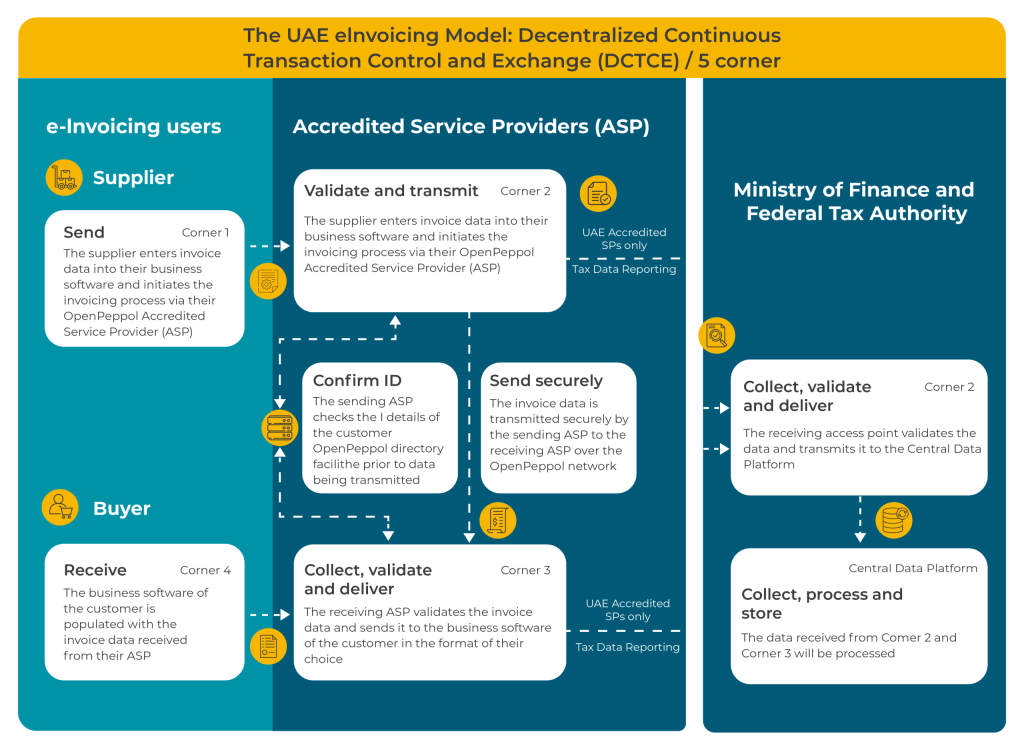
The UAE’s e-invoicing system utilizes the Decentralized Continuous Transaction Control and Exchange (DCTCE) model, based on the 5-corner Pan European Public Procurement Online (PEPPOL) framework.
Components of the 5-Corner Model:
Supplier
Generates and initiates the e-invoice
Sender ASP
Validates invoice data, converts to UAE standard XML format, and transmits
Receiver ASP
Receives the e-invoice, acknowledges it, and forwards to the buyer
Buyer
The recipient of the e-invoice
FTA Data Platform
Where tax-related data is reported, managed by the Federal Tax Authority
The UAE E-Invoicing Model
Key Aspects of e-Invoicing
The UAE Federal Tax Authority (FTA) and Ministry of Finance (MoF) are enforcing mandatory company registration for the UAE e-invoicing system by obtaining a Tax Identification Number (TIN), derived from the first 10 digits of the Tax Registration Number (TRN). This includes all B2B and B2G transactions under the UAE e-invoicing regime, regardless of VAT or corporate tax registration status.
Procedure to deliver the tax invoice
Businesses in the UAE must engage with an Accredited Service Provider to issue and receive eInvoices. The buyer’s electronic address (endpoint) will be used to share the invoice over the Peppol network.
Accredited Service Provider (ASP)
Is ASP mandatory? Yes, entities are required to engage with an Accredited Service Provider (ASP) for e-invoicing purposes. A Service Provider that is granted Accreditation to provide Electronic Invoicing Services in the UAE, in accordance with the Decision by the Ministry Of Finance.
Open PEPPOL Network
The Open PEPPOL network is a standardized, secure platform for exchanging electronic documents like invoices and orders between businesses and governments. It supports cross-border transactions through Accredited Service Providers and helps organizations comply with e-invoicing mandates.
VAT Groups
The UAE Ministry of Finance requires each member of a VAT group to individually connect with an Accredited Service Provider (ASP) while using the group’s TRN. Although each VAT group member can choose different ASPs, it is recommended to use the same ASP across the group.
Exports
For exports, overseas buyers are not required to register with a UAE ASP. If part of the PEPPOL network in their home country, their PEPPOL address will be used. Otherwise, UAE businesses must share the invoice as a PDF via email.
Self-Billing
In “self-billing” situations, where a UAE business is the buyer in an import transaction, they must create and report an e-invoice themselves. This process is aligned with the current VAT framework, and the e-invoice must be reported to the FTA and MoF through their ASP.
HLB HAMT: Transforming & Empowering Your Business in Digital Finance
At HLB HAMT, our Tax Tech consultants are ready to help your business flow smoothly into this digital transformation and compliance. Here’s how we ensure readiness:
Expert Insight
Tap into our comprehensive knowledge of current and future regulations to help you through these changes seamlessly.
Client Specific Solutions
We’ll provide strategies and systems that are specifically designed to fit the unique needs of your business and ensure digital compliance.
Proactive Planning
While awaiting the final e-invoicing regulations, our proactive approach means we’re always ready to assist your business at each transition stage.
Ready to Transform Your Business?
Reach out to us at HLB HAMT to explore how we can support your business in adapting to the digital transformation and compliance in the UAE.
Frequently Asked Questions
Is e-invoicing mandatory in the UAE?
Yes, e-invoicing will become mandatory for B2B and B2G transactions by July 2026.
Is e-invoicing only an exchange of data?
No, the invoice must be exchanged via an Accredited Service Provider (ASP), who transmits it in XML format and reports the data to the FTA.
What should businesses do to prepare for e-invoicing?
Businesses should analyze their transactions and ensure compliance with the data dictionary. Once the Ministry of Finance publishes a list of ASPs, they need to engage one and integrate their systems for invoice transmission.
Does business-to-business (B2B) include non-VAT-registered businesses?
Yes, the eInvoicing framework includes all B2B and B2G transactions, regardless of VAT registration status.
Can we develop our own e-invoicing solution internally?
No, only an ASP can exchange and report invoices. Prospective ASPs must adhere to UAE Accreditation Procedures and all related requirements.
Contact us today to find out how our expert solutions can make your payroll process and management easier and keep you compliant.
net synergies realized above the initial target in the first year.
“Partnering with Execor was a game-changer for us. They took the time to understand our challenges and helped us streamline our operations for success.”
reduction in time spent on reporting was realized
“Execor has been instrumental in our growth. Their team took the time to truly understand our needs and helped us eliminate inefficiencies.”
reduction in errors and streamlining data management through automation.
“We wouldn’t have gotten to where we are today without HLB HAMT. The HLB spent time with us to better understand our processes and where our bottlenecks were.”
net synergies realized above the initial target in the first year.
“Partnering with HLB was a game-changer for us. They took the time to understand our challenges and helped us streamline our operations for success.”
reduction in time spent on reporting was realized
“HLBhas been instrumental in our growth. Their team took the time to truly understand our needs and helped us eliminate inefficiencies.”
reduction in errors and streamlining data management through automation.